¶ Smart badges
The 'smart badge for website' menu item provides a short snippet of code that you can add to your website to display your certificate as a smart badge.
The 'smart badge for email' menu item provides a short snippet of code that you can add to your email footer or signature to display your certificate as a smart badge.
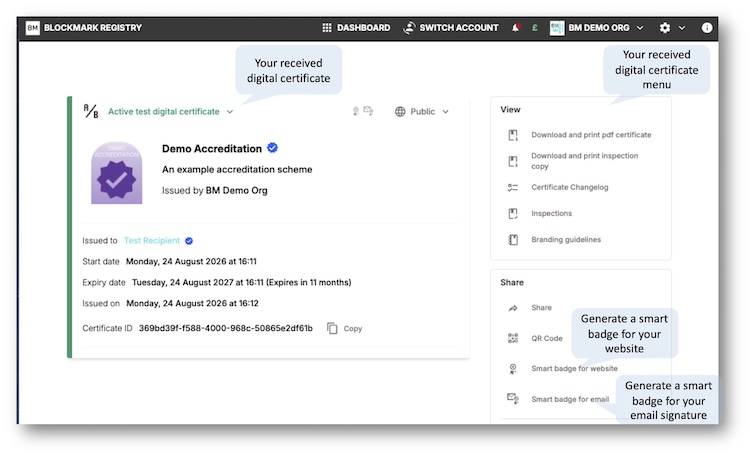
We offer these two variations because the functionality in an email is reduced compared to on a website. The website embed code is based on an iframe, but the email code is based on an image link.
The certification scheme owner will have set whether these features are available and moreover may have stipulated in the branding guidelines that these feature should be used rather than simply cutting and pasting an image file. They may even restrict the availability and use of an image file of the certification mark.
The smart badge used on a website and/or email has a number of benefits for both you (as a recipient) and the certification scheme owner (issuer):
- The badge is only displayed if your certificate is active and public. If the certificate has expired, is made private, has been suspended or has been revoked, the badge will not show*. This reduces misrepresentation and fraud.
- The certificate includes a link through to the digital certificate page where more details can be found about the certificate, the scheme, the issuer, as well as the profile of you or your organisation that is certified.
- If the certification mark is changed by the issuer to reflect a branding update or improvement to accessibility, the smart badge updates the next time it is displayed without any intervention from you, your colleagues, or your web developer.
- The website version of the smart badge shows more information when a cursor hovers over it. This can be informative to someone viewing your website.
- The website version shows a static or passing 'BM' that is becoming a recognised indicator of a smart badge with digital credentials that can then be inspected on our platform.
- If your certificate is renewed, or if you are issued with another certificate from the same scheme with a later expiry date, the badge will remain visible and the click-through will be routed to the newer certificate. This means you, your colleagues, or your web developer do not need to update anything. Note that if your original certificate is set as private, and your new certificate is public, the badge will be visible again as it will relate to the newer certificate. Similar logic applies to other states like expired, suspended and revoked.
*An option allows scheme owners to set a grace period as a number of days. This is how long a greyed-out smart badge with the words 'recently expired' will continue to display after expiry.
*Options allow scheme owners to show smart badges with 'pending', 'expired', 'suspended' or 'revoked' overlays instead of the badge just disappearing. This enables the digital certificate page to still be reached and inspected via the smart badge.
¶ Status icons
On issued and received certificate tables and cards, icons indicate if web smart badges and email smart badges are in use for each listed certificate.
The icons are coloured green if the badge was displayed within the last 7 days, orange if between 7 and 30 days, red if more than 30 days ago, and grey if never displayed. Hover-over notes also explain this.
The respective icons are only displayed if the certification scheme allows smart badges, the certificate is not self-uploaded, the certificate is set to public, and the certificate is active (not expired/suspended/revoked). These are also the conditions for which smart badges are displayed.
The status icons also take into account superseded smart badge code that is still in operation. This means that the status icons of the superseding certificate update as if it were the smart badge code for that certificate.
¶ Privacy, security & data collection
We appreciate that you may have some concerns about adding a smart badge to your email footer or website. However, we have designed the smart badge to have a very minimal impact whilst still bringing the benefits already highlighted to the issuer, recipient and inspector (viewer).
Browser-side for the web smart badge:
- No cookies are set, read or modified.
- No calls are made to any browser storage API, no service workers are registered, and no web-app manifest is referenced. The small inline script just renders the image of the badge as per the issuer's and recipient's settings.
- The image that is displayed does not contain any analytics tags, pixels, or fingerprinting.
- The click-through to the digital certificate page is a direct link with a reference that it has come from a web smart badge. This referral data is stored as a part of the digital certificate page analytics that we provide the issuer and recipient so they can see how effective their smart badges are in driving interest in their certification.
Email-message side for the email smart badge:
- No cookies are set, read or modified.
- Being a simple image endpoint, there are no scripts or code capable of calling anything further.
- The image that is displayed does not contain any analytics tags, pixels, or fingerprinting
- Note that the email smart badge is treated as a remote image by email software, so we do get a transient request to provide the image from our server, but we don't keep any extra information provided to identify the requester. We also return a single transparent pixel if the the badge is not to be displayed (e.g. the certificate has expired). This is just a placeholder and not a tracking pixel.
- The click-through to the digital certificate page is a direct link with a reference that it has come from an email smart badge. This referral data is stored as a part of the digital certificate page analytics that we provide the issuer and recipient so they can see how effective their smart badges are in driving interest in their certification.
Server-side data rentention:
- We do not log smart-badge page requests or retain any of the received information (IP address, referrer, user-agent, etc) after satsifying the request to display the smart badge.
- The limited data we store is based on two lightweight aggregation counters:
- A 'last displayed' counter which allows the recipient and issuer to know when a certificate's web or email smart badge was last displayed (see the 'Status Icons' section above).
- A 'daily display' counter that logs how many times in a day a particular smart badge is displayed. This data is stored as a part of the digital certificate page analytics that we provide the issuer and recipient so they can see how effective their smart badges are in driving interest in their certification. Note that the issuer does not receive this data on a per certificate basis, but it is aggregated across their scheme.